
IDEA INSIGHT 💡
Move Beyond Training.
Design Experiences.
Designing program architecture and shared experiences that build real leadership capability


In the first two articles in this series, we explored why many leadership development programs struggle to create meaningful change.
The first article examined common design challenges — including lack of sponsor alignment, too many topics, over-reliance on classroom learning, and weak plans for execution.
The last article focused on the first two design steps: clarifying program outcomes and selecting the leadership competencies that matter most.
Those steps provide direction. They clarify what success looks like and what leaders must be able to do differently.
But knowing the destination is not the same as designing the journey.
This brings us to the next design challenge many organizations face: how leadership development actually happens.
Leadership Capability Is Built Through Experience
When organizations begin designing leadership programs, the instinct is often to start with content delivery.
Workshops. Retreats. Training sessions. Guest speakers.
These elements can be valuable, but they rarely create meaningful leadership growth on their own.
Too often, classroom-heavy leadership programs produce two predictable outcomes.
Knowledge acquisition without behavior change.
Participants learn concepts and frameworks but struggle to translate them into daily leadership decisions.
Learning disconnected from real work.
Leadership development happens in scheduled sessions rather than in the situations where leaders actually lead.
Participants may leave sessions energized and inspired. But inspiration fades quickly if it is not reinforced through practice, feedback, and reflection.
Leadership capability develops through experience, not simply exposure.
Recognizing this distinction is what separates leadership training from leadership development.
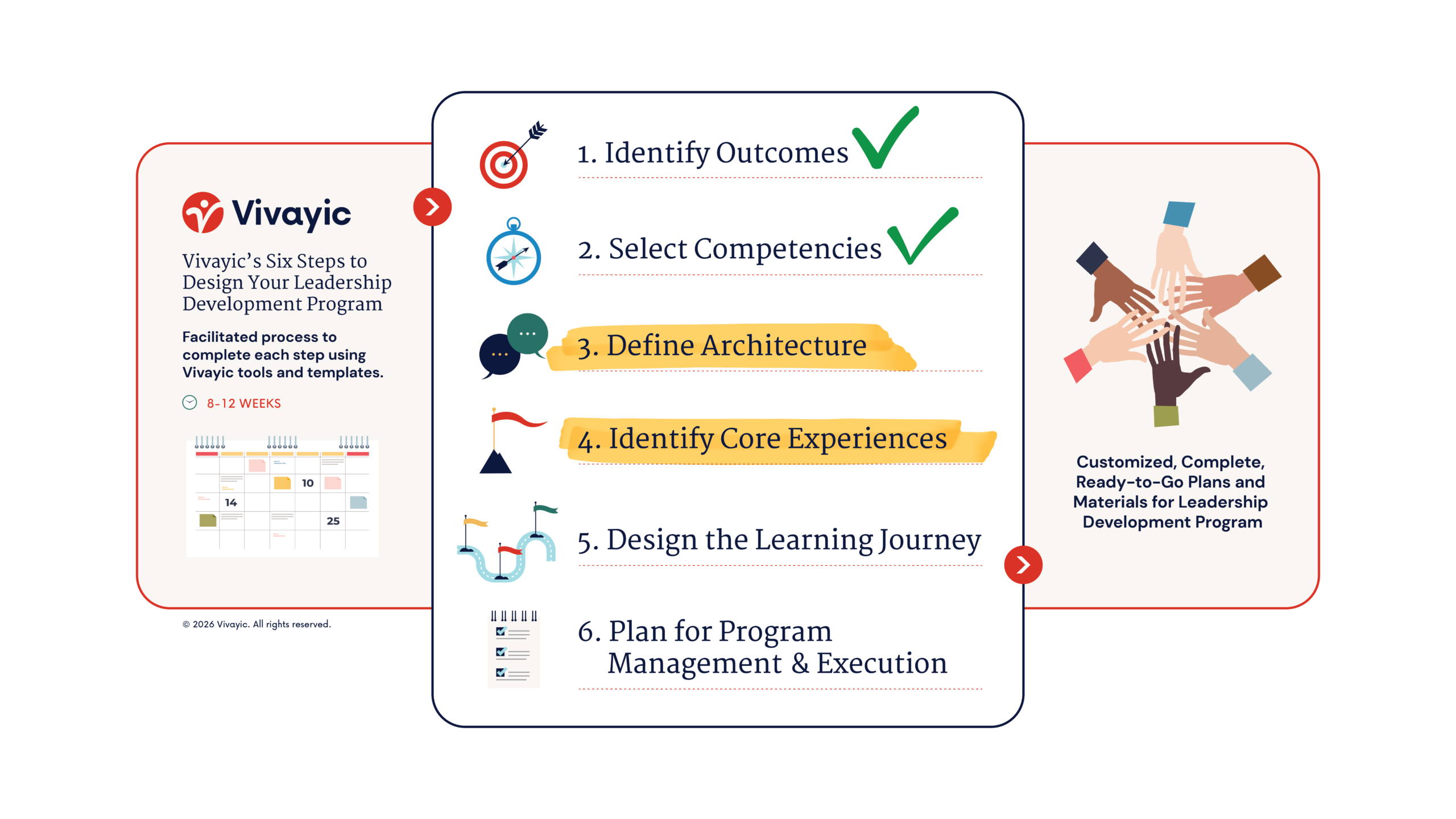
With the work already completed in steps 1 & 2, now it is time to define the program architecture and core experiences, intentionally chosen to achieve the identified program outcomes and competencies.
Let’s revisit BridgePoint Community Services to see how Bridgepoint moves from Steps 1 & 2 to Steps 3 & 4 in our program design process.
Step 3: Define Program Architecture
Once BridgePoint Community Services clarified its leadership program outcomes with input from senior leaders and selected its core competencies, the next step was determining the structure of the program itself.
In other words: What should the program actually look like over time?
Program architecture answers questions such as:
- How long should the program run?
- How often should participants meet?
- What balance of group learning, individual reflection, and applied work will be required?
- How will participation fit within the realities of participants’ roles?
For BridgePoint, this step required balancing three important considerations.
Effectiveness.
Leadership development requires time for reflection, experimentation, and growth. A one-day training or short series of workshops would not meaningfully prepare new managers for broader leadership responsibilities.
Sustainability.
BridgePoint wanted a program that could be repeated and sustained each year as new leaders emerged — not a one-time effort dependent on extraordinary resources.
Organizational realities.
Participants were responsible for delivering programs and services daily. Any leadership program needed to respect the realities of their workloads.
After considering these factors, BridgePoint designed a six-month cohort-based leadership program that included:
- Monthly half-day cohort sessions
- Small peer learning circles that met between sessions
- Applied leadership work completed within participants’ existing roles
- Two shared in-person gatherings to build relationships and reflection
This architecture created a rhythm that allowed learning, experimentation, and reflection to unfold over time without overwhelming participants or the organization.
But architecture alone does not create leadership development.
Structure provides the rhythm. Experiences create the growth.
Step 4: Identify Core Experiences
Rather than building a long list of training sessions, BridgePoint identified several core leadership experiences that would anchor the program.
These experiences were selected because they created opportunities for participants to practice the competencies identified in Article 2: developing others, communication, accountability, and managing conflict. Four experiences became central to the program.
Action Learning Projects
Participants will work in small teams to address real organizational challenges identified by senior leadership. These projects require participants to:
- Collaborate across departments
- Engage stakeholders across the organization
- Present recommendations to senior leaders
Because the work addresses real organizational priorities, participants develop leadership capability while contributing meaningful value to BridgePoint.
Peer Learning Circles
Participants are placed in small peer groups that meet regularly between program sessions. These peer circles provided space for participants to:
- Discuss real leadership challenges
- Practice coaching conversations
- Reflect on progress in their roles
- Hold one another accountable for applying what they were learning
Over time, these groups become trusted communities where leaders can speak candidly about the realities of managing teams.
Leadership Self-Assessment and 360 Feedback
Early in the program, participants will complete a leadership inventory and received feedback from supervisors, peers, and direct reports. This experience helps participants:
- Develop greater self-awareness
- Identify leadership behaviors to strengthen
- Connect feedback directly to the competencies the program was designed to develop
Participants revisit this feedback throughout the program to reflect on progress and growth.
Shared Leadership Retreat
Midway through the program, participants gather for a two-day retreat focused on reflection, relationship building, and connection to BridgePoint’s mission and values.
This shared experience allows participants to step outside their day-to-day responsibilities and reflect more deeply on their roles as leaders within the organization.
It also helps build strong peer relationships that support learning throughout the rest of the program.
Why Architecture and Experiences Must Work Together
Program architecture and core experiences are closely connected.
Structure without meaningful experiences rarely creates lasting change. Programs may be organized and well-run but fail to influence how leaders actually lead.
Experiences without structure often lose momentum. Participants may gain valuable insight but lack the continuity needed to translate that insight into sustained behavior change.
Effective leadership development requires both.
The architecture provides rhythm and continuity. The experiences create the moments where leadership growth actually occurs.
This principle is embedded in Vivayic’s name itself.
The word Vivayic is a Sanskrit word that means wisdom through experience. Leadership capability develops through doing, reflecting, and adapting — not simply through hearing or reading.
That belief is core to our company and is also key to developing meaningful leadership programs.
Connecting Experiences Over Time
Even powerful leadership experiences must be connected over time to create lasting change.
Leadership development is not a single insight or event. It is a sequence of experiences that allow leaders to practice new behaviors, receive feedback, and refine their approach.
For BridgePoint, the program architecture ensured that participants repeatedly applied what they were learning through their leadership projects, peer discussions, and reflection activities.
Over time, these repeated experiences helped new managers build both confidence and capability.
Because leadership development is not defined by the quality of a single workshop.
It is defined by whether leaders begin to think, decide, and lead differently over time.
What Comes Next
Designing meaningful leadership experiences is an important step, but experiences alone do not sustain a leadership program.
Programs also require clear ownership, facilitation plans, evaluation methods, and the ability to repeat and evolve over time.
In the next article, we will follow BridgePoint as they move into the final stages of leadership program design, ensuring the program has the execution structure and continuity needed to create lasting impact.
Because leadership development succeeds not only when experiences are powerful, but when the organization is prepared to sustain them.
Schedule a Discovery Call
Let’s work together to design and deliver a tailored learning experience that helps meet your strategic needs.

Blaze Currie
Practice Lead, Account ManagerBlaze Currie