
IDEA INSIGHT 💡
Design for Follow-Through. Not Just the Launch.
How learning journeys and execution planning turn leadership programs into lasting capability.


In the first three articles of this series, we explored why many leadership development programs struggle to create meaningful change — and what it takes to design them more intentionally.
- Article 1 highlighted common design challenges, including lack of sponsor alignment, too many topics, over-reliance on classroom learning, and weak plans for execution.
- Article 2 focused on clarifying outcomes and selecting the leadership competencies that matter most.
- Article 3 explored how program architecture and shared experiences create the conditions for leadership growth.
At this point, many organizations feel confident. The program is defined. The structure is in place. The experiences are compelling.
And yet, this is where many leadership programs begin to lose momentum. Because strong design is only part of the equation.
Follow-through determines whether the program has a lasting impact.
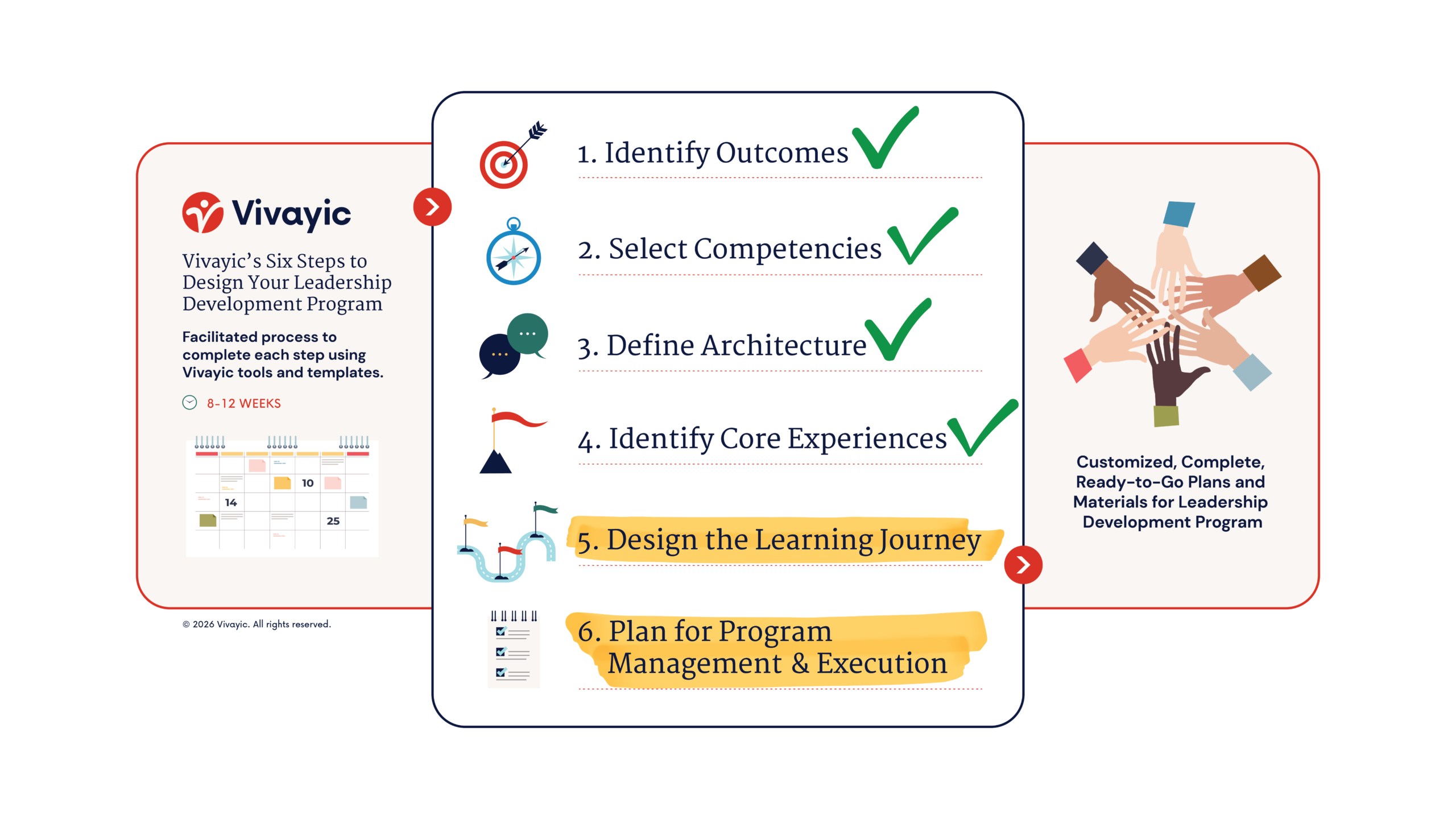
Clear ownership and a coherent learning journey ensure leadership programs stay focused, connected, and effective over time.
Leadership programs often launch with energy and intention. But over time, momentum fades. Participation becomes inconsistent. Ownership becomes unclear. Two breakdown points appear consistently.
Strong Design, Weak Delivery
Programs are thoughtfully designed but inconsistently facilitated. To the participants, experiences feel disconnected. Expectations vary. The overall impact becomes uneven.
No Clear Ownership After Launch
During design, leadership programs receive strong attention. After launch, responsibility becomes less clear.
- Who ensures the program stays on track?
- Who supports facilitators?
- Who monitors progress?
Without clear ownership, even strong programs lose focus.
From Design to Delivery: Steps 5 & 6
The final two steps address this gap:
Step 5: Design the Learning Journey
A learning journey is more than a schedule. It is the intentional sequencing of experiences so leaders:
- Build awareness
- Practice new behaviors
- Reflect and adjust
- Apply learning in real situations
A strong learning journey includes:
- Sequencing
Learning progresses over time, rather than existing as isolated sessions. - Integration
Practice, reflection, and feedback are built into the experience. - Reinforcement
Key behaviors are revisited to support retention and application. - Facilitator Preparation
Facilitators are equipped to guide learning; not just deliver content.
Step 6: Plan for Program Management and Execution
Even a strong learning journey requires disciplined execution. Step 6 ensures the program can be delivered consistently and sustained over time. Effective execution planning includes:
- Clear Ownership
Defined roles for sponsors, program leaders, and facilitators. - Operational Planning
Processes for selection, communication, and coordination. - Evaluation
Measures tied to leadership outcomes, not just satisfaction. - Sustainability
A plan to repeat and refine the program over time.
Together, Steps 5 & 6 ensure learning unfolds intentionally, experiences build over time, and the program is supported and sustained.
Without them, leadership development remains a strong idea with weak follow-through.
Let’s revisit BridgePoint Community Services to see how Bridgepoint implements steps 5 & 6 in our program design process.
Step 5: Design the Learning Journey
BridgePoint Community Services has a strong start. They have defined outcomes, competencies, program architecture, and core experiences. Now it is time to put all of this into action.
When BridgePoint Community Services reached this stage, they mapped the participant experience across the full six months.
Early in the program, participants focused on:
- Self-awareness
- Leadership expectations
- Building trust within the cohort
Midway through the program, emphasis shifted to:
- Applying leadership skills
- Navigating conflict and accountability
- Strengthening communication
Later in the program, participants focused on:
- Developing others
- Leading through complexity
- Demonstrating readiness for broader roles
Reflection and reinforcement were built into peer learning circles, action learning projects, and facilitated sessions.
This ensured leadership development was a progression, and not a series of events.
For participants, this leadership program will feel connected and intentional with each phase building on the last, reinforcing learning and shaping how they lead over time.
Step 6: Plan for Program Management and Execution
The program design team at BridgePoint worked with senior leadership to approve a clearly articulated plan for program management and execution.
First the started with roles and responsibilities:
Program Sponsors
Provided strategic alignment, reinforced the importance of the program, and stayed connected to outcomes over time. They plan to reconvene once a year to review the program and provide recommendations for improvement.
Program Lead
A program lead was assigned to manage day-to-day coordination, communication, and logistics, ensuring the program stays on track and aligned to its intended design.
Facilitators
A combination of internal and external facilitators were identified to lead sessions, guide discussion, support reflection, and help participants connect experiences to real leadership behaviors.
The program design team also established:
- Clear participant selection criteria aligned to leadership pipeline needs
- Defined expectations for participant engagement and supervisor support
- Evaluation methods tied to the program outcomes and competencies identified in steps 1 & 2
BridePoint launched this program with a plan to see it through fruition.
For participants, this created a consistent and supported experience — one where expectations were clear, facilitation was aligned, and the program felt cohesive from start to finish.
Leadership Development as an Organizational Capability
When Steps 5 and 6 are done well, leadership development shifts.
It becomes a repeatable capability, not a one-time program.
A capability to:
- Develop leaders consistently
- Strengthen the leadership pipeline
- Reinforce organizational priorities
- Adapt over time
This is where leadership development moves from activity to impact.
Our mission at Vivayic is to build the capacity of others to do good in the world. It is why we love what we do. When this six-step process is complete, that is what is being build – capacity.
The capacity to prepare leaders, strengthen organizations, and create lasting impact over time.
What Comes Next
At this point, every element of leadership program design is in place:
- Outcomes and alignment
- Focused competencies
- Program architecture
- Core experiences
- Learning journey
- Execution plan
In our final article, we will bring these elements together. Because leadership development works best when every part of the design is aligned, intentional, and built to last.
Schedule a Discovery Call
Let’s work together to design and deliver a tailored learning experience that helps meet your strategic needs.

Blaze Currie
Practice Lead, Account ManagerBlaze Currie