Three Questions to Help You Choose the Right Path
How much upfront budget do you have?
Custom-built LMS solutions typically require a significant upfront investment. The cost reflects the work involved in designing, building, testing, and launching a system tailored to your strategy. For many organizations, this investment makes sense when the LMS is central to their business model or mission and must support highly specific workflows or experiences. It’s not uncommon to see custom LMS solutions require an initial investment of $75k+ depending on the level of complexity and customizations.
Subscription-based LMS solutions, by contrast, have a lower cost to get up and running. Some sub-scription-based services will allow you to get up and running for $5-8k if you have a relatively small audience (<500 learners). This makes subscription models appealing to get up and running quickly or pilot a program.
When considering budget, it’s also helpful to look beyond year one. Ongoing costs—such as subscriptions, hosting, maintenance, and support – add up over time. The goal isn’t to minimize cost, but to choose a cost structure that aligns with your organization’s financial reality and long-term plan for the system.
How important is customization?
Said differently: Do we need the LMS to adapt to us—or are we willing to adapt some of our processes and programs to the LMS?
If your strategy depends on highly specific workflows, unique learner journeys, or deep integration into other systems, a custom-built LMS may offer the flexibility you need. Custom solutions allow you to design the system around your processes, rather than adapting your processes to fit the system.
That said, customization comes with tradeoffs. More flexibility typically means more decisions, longer development runways, and greater responsibility for ongoing maintenance and enhancements.
Subscription-based LMS solutions generally offer lower levels of customization, especially at the interface or workflow level. Many organizations find that “out-of-the-box” functionality may require workarounds to fit their desired workflows and learning program structure. However, many are open to this as a tradeoff for speedy implementation and lower start-up costs.
How quickly do you need to launch?
Timeline is often the other deciding factor, even when budget and customization are important.
If you have an immovable deadline – such as a compliance cycle, onboarding surge, product launch, or grant requirement – subscription-based LMS solutions are typically better positioned to meet short timelines. Many can be configured and launched in weeks rather than months.
Custom-built LMS solutions, by nature, take longer. The payoff is a system designed specifically for your needs, but the runway must be long enough to support thoughtful design, development, and testing. For organizations with flexible timelines and a long-term vision for their LMS, this investment can pay off over time.
It’s also worth remembering that timelines don’t have to be all-or-nothing. Some organizations take a phased approach, launching a limited version of the system first, then expanding functionality or audiences over time.
Beginning Your Search with Intention
Once you’ve identified the type of solution that best fits your needs, it’s time to begin researching options. A few simple practices can help keep the process focused.
Identify Defining Search Terms
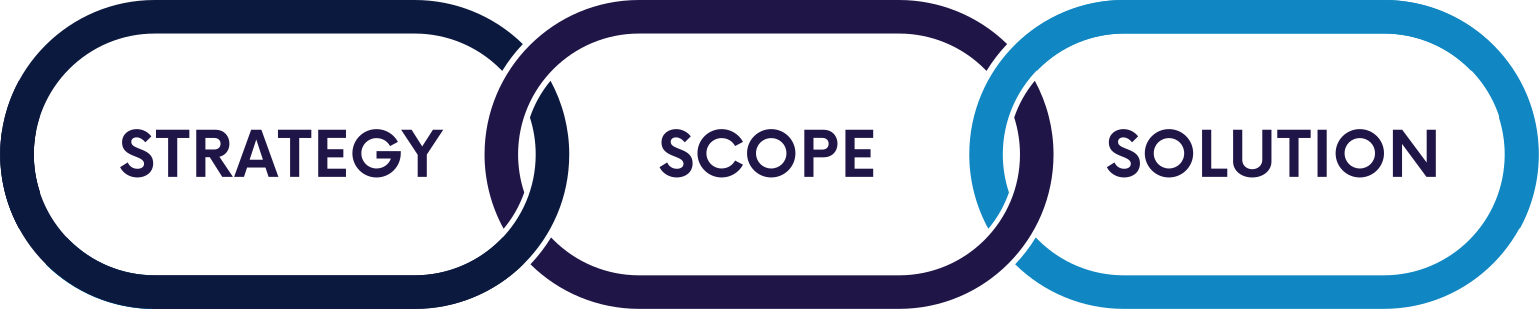
Reflect on your strategy, scope, and the solution type and pick 3-5 key search terms that most define the LMS you’re looking for (e.g., subscription-based LMS for 500+ users with webinar tracking and basic reporting). Use these to guide online research with tools such as generative AI. This will help you develop an initial list of prospects to explore first.
Create a Simple RFP/Brief
Unless it’s required by your organization, you don’t need a lengthy RFP to start conversations. Use the answers you’ve captured on the strategy and scope worksheets to create a simple RFP or project brief to share with prospective partners. Sharing your needs and constraints up front will help them customize their demonstrations and allow you to get the answers you need to assess fit.
Make a Scorecard
Use the strategy, scope, and solution parameters you’ve identified to create a scorecard. Be sure to give extra weight to scores for your must-haves versus the nice-to-have features that sound appealing. This will help you stay consistent and focused on what matters most as you evaluate each solution and avoid getting caught up in a great sales pitch!
Bringing It All Together
Finding the right LMS solution isn’t about chasing features—it’s about alignment. With a clear strategy, defined scope, and understanding of the solution landscape, you’re well positioned to make a confident, informed decision.