

The Problem with “Learning” That Doesn’t Last
Ever participated in a training, read an article, or clicked through an online module and walked away thinking, “Well, that was… something.” You’re not alone.
In today’s fast-paced, information-saturated world, nearly everything is labeled as “learning.” But not every experience leads to new understanding, better performance, or changed behavior. The difference between something that’s memorable and something that’s meaningful comes down to intentional design.
Beyond Information Sharing
The internet is overflowing with how-tos, explainers, and expert insights. Access to information has never been easier, but access alone doesn’t equate to learning.
A learning experience is more than a video, PDF, or slide deck. It’s a thoughtfully designed journey that:
- Builds on what learners already know,
- Challenges them to apply new knowledge or skills, and
- Supports reflection and behavior change over time.
In short, learning isn’t about knowing more; it’s about doing more with what you know.
The Science Behind How We Learn
Designing meaningful learning means understanding how people think, focus, and make sense of new information. Three core ideas shape effective learning design:
- Attention Economics reminds us that learners have limited cognitive resources. In a world of constant notifications and competing priorities, we must earn and keep their focus.
- Andragogy (Knowles, 1984) reminds us that adult learners learn best when experiences are self-directed, relevant, and grounded in real-world context, rather than relying on the more instructor-driven approaches of traditional pedagogy.
- Schema Theory (Piaget, 1952; Anderson, 1977) tells us that people interpret new information through the lens of what they already know. Ignoring this can cause confusion or disengagement when content feels disconnected from a learner’s experience.
These principles remind us that effective learning design starts with empathy for how humans process, connect, and apply knowledge.
Vivayic’s Perspective: Levels of Learning
At Vivayic, we frame learning design across three levels, based on what the learner needs to do after the experience.
Level 1: Learning for Information Recall
When a learner needs to recall or reproduce specific information, content should be organized and sequenced to drive memory and understanding. This approach works well when learners need to know key facts—such as product details or terminology—without constant reference. Typical methods include recall activities, quizzes, and knowledge checks to reinforce learning.

Level 2: Learning for Application
When learners must take what they’ve learned and put it into practice, the experience must include instructional guidance, modeling, and opportunities for transfer. Scenario-based activities, simulations, and structured feedback help bridge theory and action. Madeline Hunter’s Elements of Effective Instruction (1982) aligns well with this approach, emphasizing modeling, guided practice, and feedback to support real-world performance.

Level 3: Experiential Learning for Behavior and Mindset Change
When the desired outcome is a change in mindset or behavior, learning must engage both reflection and active experimentation. These experiences require depth, emotional engagement, and sustained reinforcement. David Kolb’s Experiential Learning Model (1984) offers a useful framework for designing transformational learning through experience, reflection, conceptualization, and application.
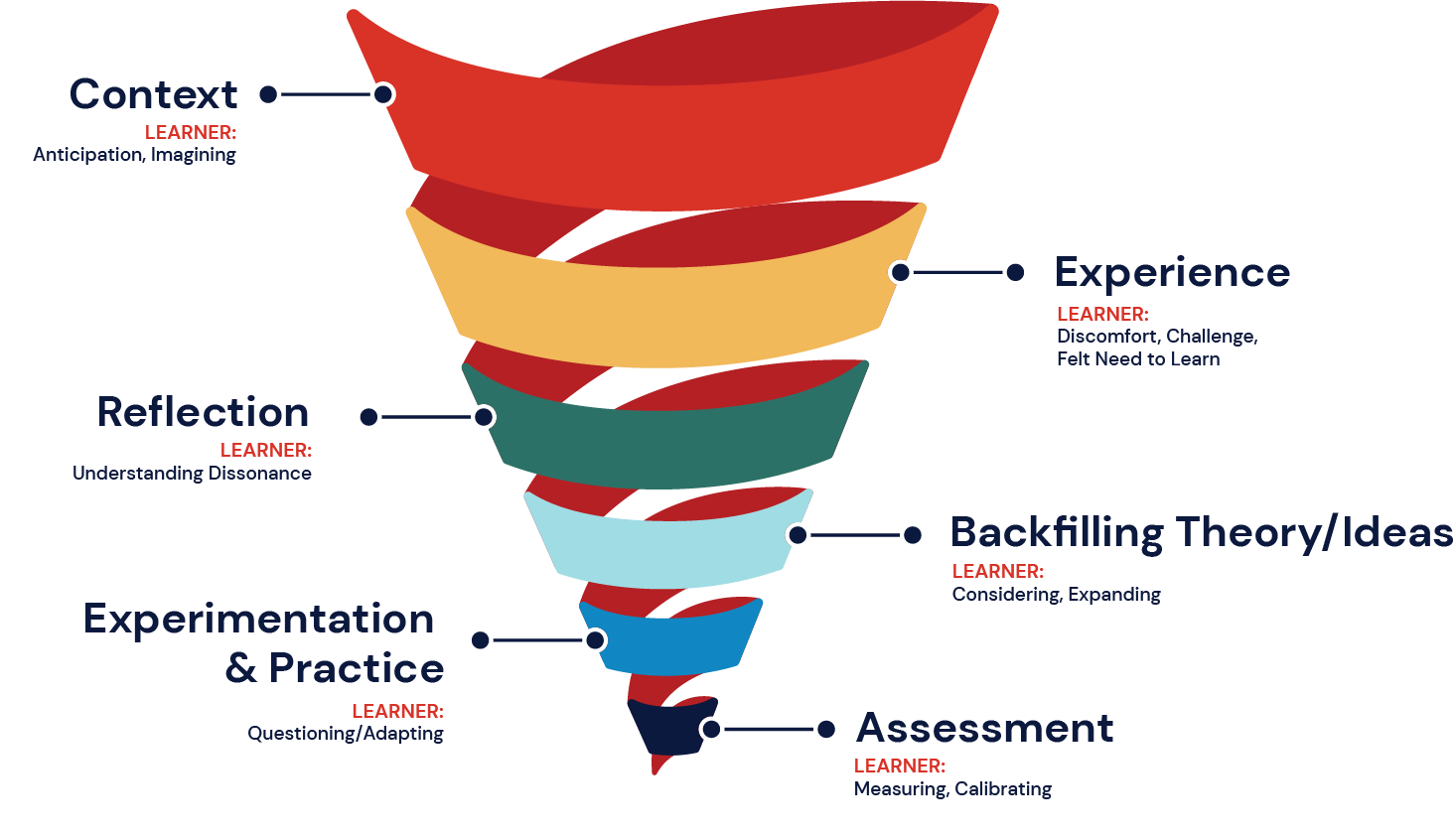
Each level calls for thoughtful learning design and varying strategies, supports, and outcomes.
Redefine “Learning” in Your Organization
Learning isn’t about delivering more content; it’s about creating the right conditions for change. Before launching your next course, resource, or learning experience, pause to consider:
- Are we sharing resources or designing experiences?
- Do our learning programs aim for awareness, or do they build toward application and change?
- What do we expect learners to do differently after this experience?
- Have we designed the right supports, interactions, and reinforcements to make it stick?
Let’s Make Learning Stick
Learning that sticks doesn’t happen by chance; it happens by design. If you’re questioning whether your current programs are creating real change, we can help you find clarity.
Schedule a Discovery Call with our team to explore how your goals, audience, and outcomes can guide the right learning design strategy. Come ready to share one area where you wish learning stuck more deeply and we’ll build from there.