


Imagine a task that normally takes five hours. You use AI, and now it takes one. That’s a win, right? Probably.
But here’s the question I think merits some discussion: What happens to the other four hours?
If we simply use those four hours to produce five times as much stuff, we’ve gained efficiency. That’s useful. There are plenty of tasks where doing the same work faster, cheaper, or with less effort creates real value. But what if those four hours allow someone to spend more time with a customer? Coach an employee? Think through a difficult problem? Improve the quality of a learning experience? Practice a new skill? Interpret what the data actually means? That’s a different kind of value. It’s why I think organizations need to be careful about treating time saved as the finish line for AI. Efficiency creates capacity. What we do with that capacity determines its value.
Faster is valuable, but it’s only the beginning.
There are a lot of good reasons to use AI for efficiency. At Vivayic, we use a variety of AI enabled tools, depending on the task. AI can help us organize information, synthesize source material, explore ideas, translate to another language, create starting points, compare options, and accelerate portions of work that would otherwise require more time. That’s huge! For those of you who have been early adopters, just think how you used to do all those tasks. But the more interesting question isn’t whether AI helped us complete a task faster; it’s whether the work became better because of what that efficiency made possible.
One simple way to think about this is as three levels of value: Efficiency → Effectiveness → Reinvention
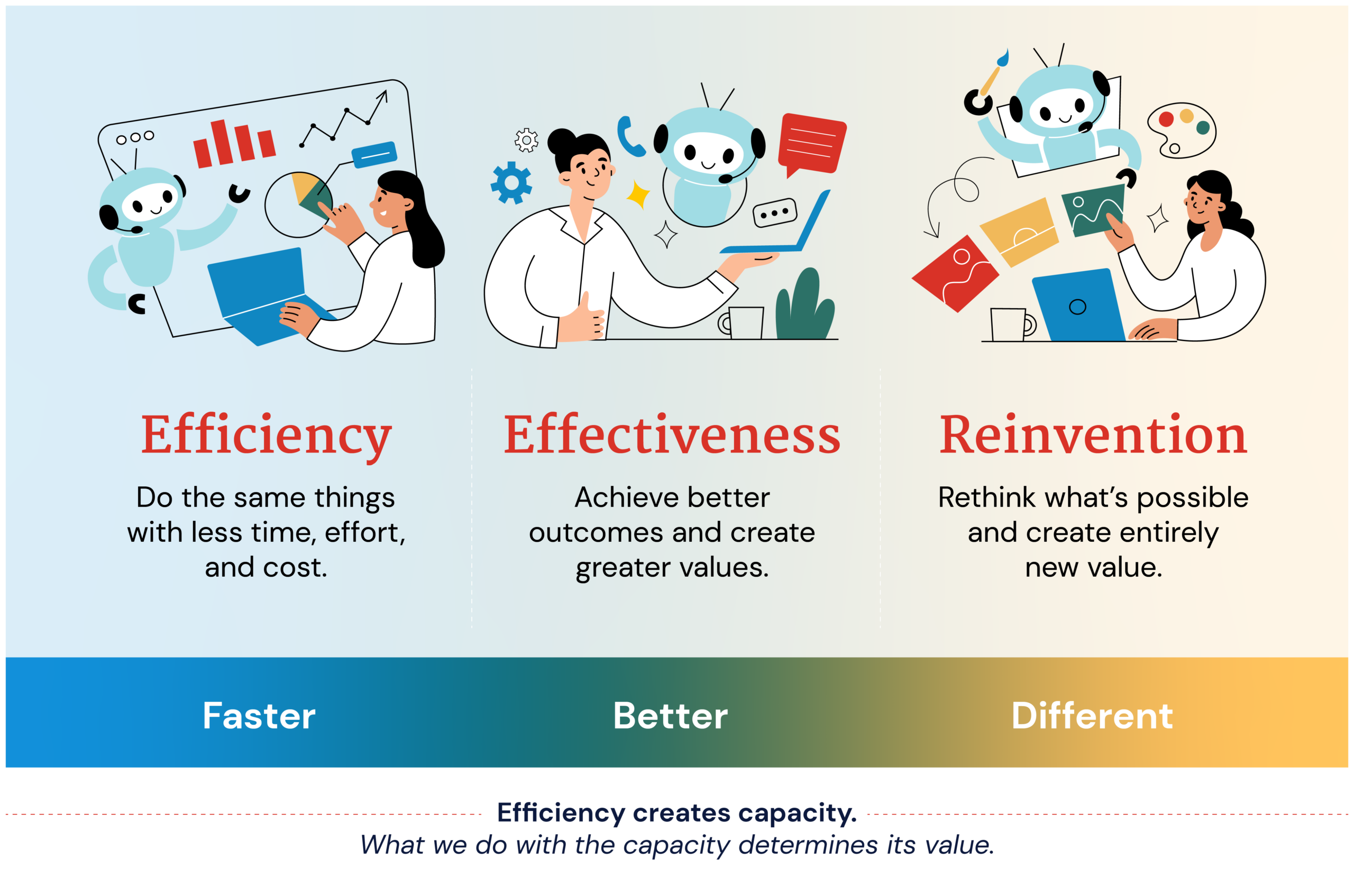
Or, even more simply: Faster → Better → Different
Efficiency: Faster
At the first level, AI helps us do the same work with less time, effort, or cost.
- A first draft takes 20 minutes instead of two hours.
- Hundreds of survey comments can be organized quickly.
- A large collection of source material can be summarized before a person begins deeper analysis.
Those are legitimate gains. And sometimes that’s all we need. Not every task needs to be transformed. Sometimes faster really is better.
Effectiveness: Better
The second level asks a different question: Did the work itself improve?
- Maybe a learning designer uses AI to get through the initial synthesis faster, then spends more time developing a meaningful scenario.
- Maybe an analyst can spend less time organizing data and more time interpreting what the findings actually mean.
- Maybe a facilitator can generate several realistic case variations and give learners more opportunities to practice.
- Maybe an instructional designer can explore multiple approaches before deciding what best fits the audience.
AI is still creating efficiency, but the benefit is showing up somewhere else: better thinking, better design, better practice, better decisions, or better learner support.
Reinvention: Different
The third level is where things get especially interesting. Sometimes a new capability allows us to reconsider the work altogether.
- A salesperson who once practiced a difficult conversation once during an annual workshop may now be able to practice it several times before meeting with a customer.
- An employee who once had to remember every step from a course may be able to access reliable guidance while doing the task.
- A learning team that once created one experience for everyone may have more options for adapting support to different roles or needs.
At that point, we’re no longer simply doing the old work faster. We’re asking: If this capability had always existed, would we have designed the work this way in the first place? That’s reinvention!
Three simple rules we use at Vivayic
Of course, “different” isn’t automatically better either. New technology gives us more options. It doesn’t relieve us of the responsibility to make good choices. At Vivayic, we’ve been trying to keep those choices fairly simple. We use three Simple Rules to guide our own use of AI:
Align with Outcomes. Honor Humanness. Maintain Transparency.
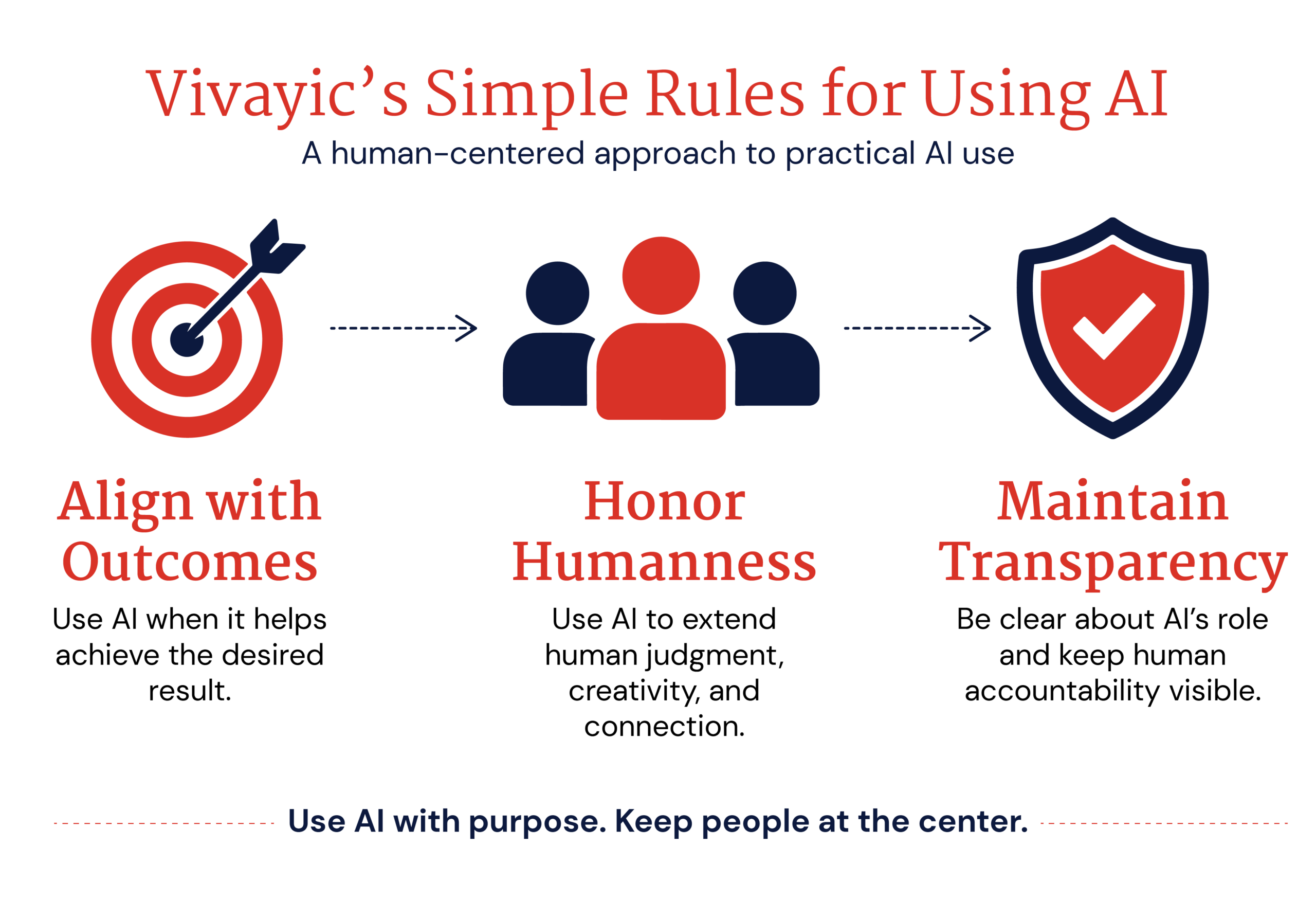
They weren’t created as an AI strategy or a complicated governance framework. They’re simply guides that help us make decisions as AI becomes part of more of our work.
And I’ve found that they’re also a useful way to think about value.
#1 Align with outcomes
Our first rule is straightforward: Use AI when it aligns with the desired outcome. Don’t use it when it doesn’t. That sounds obvious. But new technology creates a powerful temptation to ask, “How could we use AI here?” That’s different from asking, “Would using AI actually help us accomplish what we’re trying to accomplish?” Imagine we’re designing an instructor-led learning experience where the real value comes from people talking with one another, wrestling with a difficult decision, getting feedback, and learning from the experiences of others. We could probably add AI somewhere. But should we? Maybe. Maybe AI can help create scenarios ahead of time or support follow-up practice afterward. But inserting it into the experience simply because it is available could just as easily get in the way. The outcome should win. The same principle applies when we’re building a Rise course, designing an assessment, analyzing research, or creating a performance-support tool. AI is useful when it moves the work toward the desired result, not simply when it allows us to say we used AI.
#2 Honor humanness
Our second rule may be the one I think about most. We want AI to extend human work, not erase the value people bring to it. That includes things people are particularly good at empathy, discernment, critical thinking, emotional intelligence and, sometimes, simply reading the room!
Those things become especially important as the work becomes more consequential or ambiguous. Consider something fairly ordinary in our own work. AI may be able to help a learning analyst get to a first draft of an outline much faster. Great! But the most valuable outcome isn’t necessarily that the analyst can now create more outlines. Maybe the value is that the analyst has more time to ask better questions of the SME, or rethink an activity that isn’t working, or make the language clearer for the learner, or develop a scenario that actually feels like something the learner might encounter. The AI-generated efficiency created capacity. The human decides how to use it.
#3 Maintain transparency
Our third rule is to be transparent about AI’s role. We don’t think every use of AI needs a flashing label attached to it. But we also don’t think AI should become a hidden black box. People should understand when AI has meaningfully contributed to the work, particularly when that contribution affects decisions, data, trust, or the integrity of the final product. That’s one reason I include a note explaining how AI was used in developing these articles. Transparency isn’t just about disclosure; it’s also part of quality. If nobody knows where AI contributed, who is responsible for checking the output? Who owns the final decision? Who verifies that something is accurate? Those questions matter, and they lead to a broader issue organizations need to address.
Simple rules don’t replace governance
Every organization needs some level of clarity around responsible AI use. What that looks like will vary considerably.
For a smaller organization, it may be fairly straightforward:
- Which AI tools are approved?
- What information should never be entered?
- What needs to be checked before it is used?
- When should people disclose AI’s involvement?
- Who ultimately owns the work?
In a larger or more regulated organization, the expectations may need to go much further with formal policies, security requirements, privacy protections, procurement standards, risk categories, review processes, human oversight, legal guidance, or ongoing monitoring.
The Association for Talent Development (2025) makes a similar point in AI Governance in Talent Development: A Strategic Framework – responsible AI use isn’t simply a technology issue. Governance helps protect people, information, trust, and the quality of organizational decisions. That doesn’t mean every employee needs to become an AI governance expert. It does mean people need to understand the boundaries well enough to behave responsibly within them. Learning has a role in making those boundaries understandable and usable.
What does value look like in learning?
These ideas become especially important in learning and development because AI is making it much easier to produce learning content. Consider a few familiar examples:
A Rise course
AI may help organize SME content, suggest an initial structure, draft explanations, or generate possible assessment questions. That can absolutely make development faster. Perhaps, though, the real value is what the designer can now spend more time understanding the learner, improving the examples, or making the experience accessible.The goal isn’t to make the most courses in the least time; it’s to create the right learning experience efficiently without losing what makes it effective.
An instructor-led experience
AI might help create case studies, brainstorm activities, generate scenario variations, or support facilitator preparation. However, an excellent ILT still depends heavily on things AI can’t simply manufacture:
- The facilitator noticing confusion.
- A well-timed follow-up question.
- The moment when an abstract concept finally connects to someone’s real work.
If AI helps us create more space for those things, that’s value.
Research and analysis
AI can make working with large amounts of qualitative [and quantitative] information dramatically faster. Organizing comments, however, isn’t the same as understanding them. A human still has to ask:
- What pattern matters?
- What’s missing?
- Does this finding make sense in context?
- How confident should we be?
- What should someone do with this information?
AI may accelerate the path to the analysis. Human judgment and discernment turns this analysis into insight.
Measure what matters
As AI adoption grows, organizations will naturally want evidence that it’s paying off. That’s good! We should be thoughtful, though, about what we measure.
Measures such as number of AI users, licenses, prompts, hours saved certainly does tell us something; mainly feedback on activity and efficiency. Perhaps, better questions are closer to the outcome:
- Did the quality improve?
- Did someone make a better decision?
- Did performance actually change?
Harvard Business Review has recently published articles (Masinter, 2025; Furr & Shipilov, 2025) on the value of AI. Several point that organizations eventually have to move beyond experimentation and rethink how AI connects to the ways they create value in the first place.
Don’t stop at faster
AI will make many things faster. But speed alone isn’t the destination. The bigger opportunity is to ask what becomes possible because we gained that time, capacity, or capability.
- Can people spend more time doing work that benefits from human judgment?
- Can learners get more opportunities to practice?
- Can experts spend less time organizing information and more time interpreting it?
- Can we create support that wasn’t previously practical?
- Can we rethink a learning experience instead of simply producing the same thing more quickly?
Those questions move us beyond AI activity and toward actual value. At Vivayic, our Simple Rules give us a straightforward place to start:
Align with the outcome. Honor what humans uniquely bring to the work. Be transparent about AI’s role.
Then ask the question that matters most: What became better because we used it?
Works Cited
Masinter, A. W. (2025, November 19). Prioritizing AI investments that create real value. Harvard Business Review. https://hbr.org/2025/11/prioritizing-ai-investments-that-create-real-value
Furr, N., & Shipilov, A. (2025, August 29). Beware the AI experimentation trap. Harvard Business Review. https://hbr.org/2025/08/beware-the-ai-experimentation-trap
For further reading
Harvard Business Review — Prioritizing AI Investments That Create Real Value
A useful executive-level look at moving beyond AI experimentation and focusing investment on the places where AI can actually change how an organization creates value.
ATD — AI Governance in Talent Development: A Strategic Framework
A practical resource for thinking about responsible AI use in talent development, including trust, oversight, policy, risk, and the human side of governance. ATD includes it within its current collection of AI tools for talent development leaders.
A note on how this article was developed: I intentionally used generative AI as a thought partner in developing portions of this article—not as a replacement for human judgment. I guided the process, challenged and refined the output, and takeresponsibility for the final ideas and language. In doing so, I aimed to model Vivayic’s approach to AI: use it when it supports the outcome, preserve the human contribution, and be transparent about its role.
