


Artificial intelligence is quickly becoming a normal part of work. People are using it to summarize information, generate ideas, organize data, draft emails, create images, analyze documents, and tackle dozens of other everyday tasks. New AI features are also appearing inside the software many of us already use. At Vivayic, we use AI in our work too, when it benefits the client. But the more we use it, the more convinced I am that “What can AI do?” is usually the wrong place to start. A better question is: What are we trying to accomplish, and where, if anywhere, can AI help us do that work better?That distinction matters. Starting with the technology can quickly lead to a solution looking for a problem. Starting with the work keeps the focus where it belongs: on the outcome, the people doing the work, and what will actually help them succeed.
Start with the work
Imagine a team receives access to a new AI tool. People attend a demonstration. Someone shares a list of useful prompts. A few employees start experimenting right away. Others barely touch it. Six months later, leaders can say people are “using AI,” but it is harder to answer a more important question: What actually got better? This isn’t really an AI problem. It’s a performance problem. The same thing can happen in learning and development. Someone decides they need a course, an instructor-led workshop, a video, or an eLearning module before fully understanding what people need to do differently.
At Vivayic, we spend a lot of time helping clients work backward from the desired outcome. What does success look like? What does someone need to know, do, or decide? What is getting in the way today? Only then should we decide what kind of learning or support makes sense. AI deserves the same discipline.
Before deciding where AI belongs, ask questions like:
- What are we trying to accomplish?
- Where is time currently being spent?
- Which parts of the work are repetitive or information-heavy?
- Where is judgment required?
- Where do relationships, empathy, context, or consequences matter?
- What does someone truly need to know versus simply have access to?
- If AI changes the work, what new capability might people need?
The goal isn’t to find work for AI. The goal is to find the best way to accomplish the work.
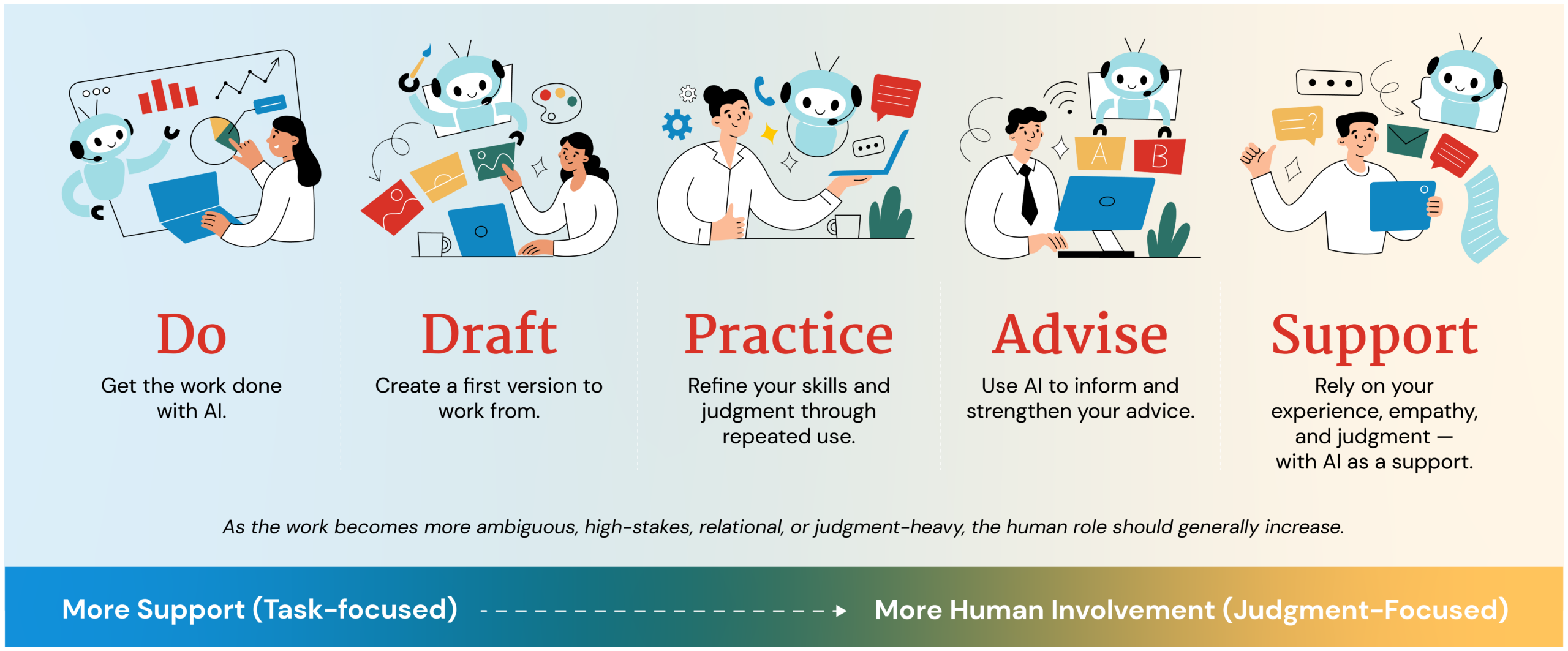
So, what role should AI play?
One simple way to think about this is to consider the role AI is playing in the work.
Do
Some work is repeatable, relatively low risk, and easy to verify. AI may be able to do much of that work directly: organizing information, formatting content, categorizing responses, producing routine summaries, or completing other administrative tasks. The human role is still important, but it may primarily involve setting expectations and checking the result.
Draft
In other situations, AI may be most useful as a starting point. It can synthesize source material, create a first draft, generate alternatives, or develop an initial structure. The human then reviews, challenges, contextualizes, and improves the output. This is already one of the most practical ways many of us use AI today.
Practice
This is where things start to get especially interesting for learning. AI can become a practice partner. A salesperson can rehearse a difficult customer conversation. A manager can practice giving feedback. A learner can work through a scenario and get another opportunity to try again. AI doesn’t have to simply create learning content. In some cases, it can become part of the learning experience itself.
Advise
AI can also help people make sense of complex information. It might surface patterns, suggest questions, identify alternatives, or help someone think through possible responses. But the important distinction is that the person still makes the decision. AI informs judgment rather than replacing it.
Support
Finally, some work is highly ambiguous, relational, consequential, or dependent on context. Leadership. Coaching. Difficult conversations. Ethical decisions. Complex stakeholder situations. AI may still have a role, but the role changes. It might help someone prepare, retrieve information, consider alternatives, or challenge their thinking. But human experience, empathy, creativity, discernment, and judgment remain central.
In general, think of it like this: As the work becomes more ambiguous, high-stakes, relational, or judgment-heavy, the human role should generally increase.
What does this look like in learning?
This is also where I think conversations about AI can sometimes move too quickly. It is easy to jump from “AI can generate content” to “We won’t need as much learning development.” But producing content has never been the whole job. Consider a few examples.
Turning expertise into learning
Suppose an organization has dozens of technical documents, presentations, and SME interviews that need to become a learning experience. AI can be incredibly helpful. It might organize source material, summarize themes, identify repeated concepts, or create a first-pass outline. That can save real time.But someone still needs to determine:
- What does the learner actually need?
- Which information is essential and which is merely interesting?
- How should the content be sequenced?
- Where is explanation enough, and where does someone need to practice?
- How will we know whether learning occurred?
- And how do we make the experience accurate, relevant, accessible, and useful?
The answer might ultimately be an Articulate Rise course. It could be a Storyline experience. It might be an instructor-led workshop, a facilitator guide, a job aid, or some combination of those things. AI can accelerate parts of the process, but it doesn’t decide what good learning looks like.
Building a complex skill
Now imagine a sales team needs to improve how it handles challenging customer conversations. AI could help create realistic role-play opportunities. A salesperson could practice repeatedly without needing a manager or facilitator available every time. That’s exciting! But before anyone builds the AI simulation, someone still needs to determine what excellent performance looks like.
- What decisions matter?
- What makes the scenario authentic?
- Which parts are appropriate for independent practice, and which deserve conversation with a facilitator, manager, or peer?
The right answer may involve AI. It may also involve an instructor-led experience where people practice face-to-face, observe others, receive feedback, reflect on what happened, and try again. Often the strongest solution will be both. The learning strategy should determine the technology, not the other way around.
Supporting people in the moment
AI also creates interesting opportunities for performance support. Imagine employees routinely need access to a large amount of complex information. Historically, we might have tried to teach more of that information so people could remember it later. But AI and other search technologies create a different possibility: make the right information available at the moment it is needed. That changes the learning-design question. Does someone actually need to know this, or do they simply need reliable access to it? If they need to understand foundational concepts and make good decisions, training may still be necessary. If they simply need the right specification, process, or reference information at the right moment, a job aid, searchable knowledge resource, or AI-supported tool may be more useful. Sometimes the answer will be both: build the foundational understanding first, then provide support when the person is actually doing the work.
Easier content makes good learning design more important
AI is lowering the barrier to creating things. Slides. Scripts. Quiz questions. Videos. Images. Course outlines. Explanations. Entire learning modules. That can be incredibly useful! But, easy production creates a new challenge: Just because we can make something quickly doesn’t mean we should make it.The harder questions haven’t disappeared.
- Who is this for?
- What are they trying to accomplish?
- What should they do differently afterward?
- What deserves practice?
- What requires human interaction?
- How much learning is actually necessary?
- What would help someone perform better in the real world?
Those questions are why learning analysis, instructional strategy, SME engagement, facilitation, practice design, assessment, and evaluation still matter. Content may become easier to make. Effective learning is still intentionally designed.
A simple place to start
You don’t have to redesign your entire organization around AI. Pick one meaningful workflow, then map it: Desired outcome → Current work → Friction → Required judgment → Possible AI role → Human role → Learning or support needed
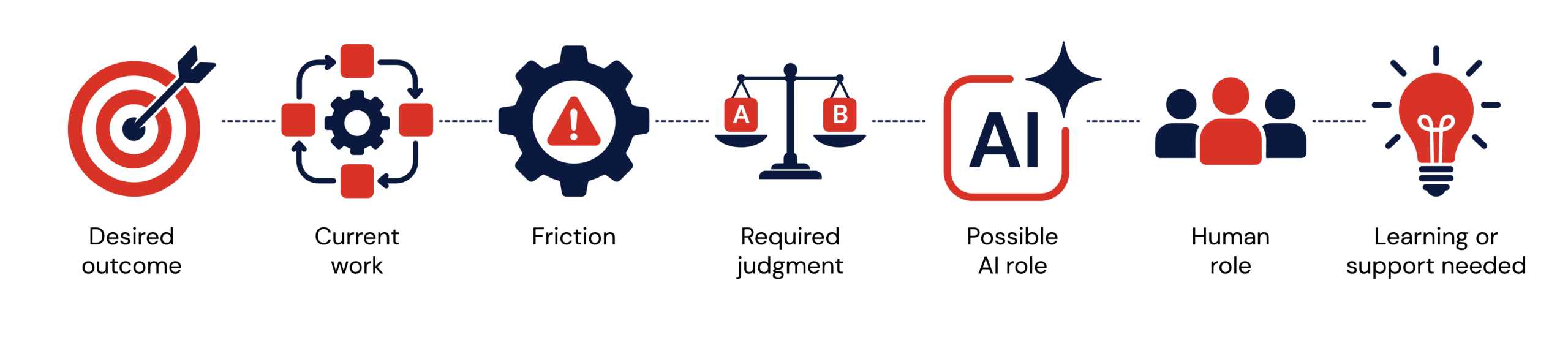
You may discover an obvious place where AI can save time. You may find an opportunity to give someone much more practice than was previously practical. You may realize a course is no longer necessary because people simply need information in the flow of work. Or, you may decide that the most important part of the work is deeply human and shouldn’t be automated at all. All of those can be good answers.
Keep the work at the center
AI will keep getting more capable. The list of things it can do will continue to grow, which makes it even more important not to begin there. Begin with the outcome. Understand the work and the people doing the work. Then, decide what combination of technology, learning, practice, and human judgment will help them succeed.
Because the most useful question isn’t “What can AI do?” It’s: What are we trying to accomplish, and what is the best way to get there?
For further reading
ATD — AI Job Impact Toolkit: 4 Tools to Map How Jobs Are Changing
A practical resource for thinking about how AI changes tasks and roles, including the difference between automation, augmentation, and work that remains distinctly human.
Josh Cavalier — AI for L&D: Insights, Workflows & Practical Tips
A useful look at the growing AI ecosystem in learning and development and the many ways these tools are beginning to show up in L&D work.
A note on how this article was developed: I intentionally used generative AI as a thought partner in developing portions of this article—not as a replacement for human judgment. I guided the process, challenged and refined the output, and take responsibility for the final ideas and language. In doing so, I aimed to model Vivayic’s approach to AI: use it when it supports the outcome, preserve the human contribution, and be transparent about its role.
