


Imagine this announcement goes out on Monday morning, “Good news! Everyone now has access to our new AI tools!”
By Tuesday afternoon, someone is already asking, “Why aren’t more people using them?”
Or maybe the opposite happens. People use them immediately, but not particularly well. Some trust nearly everything AI produces. Others don’t trust it at all. Some put sensitive information into places they shouldn’t. Others are so worried about doing something wrong that they avoid the tools entirely. A few people become incredibly proficient. Everyone else is trying to figure out what “good use” actually looks like. That’s because access isn’t the same as readiness.
Giving someone a new tool changes what they have available. It doesn’t automatically change what they know, how they make decisions, or how effectively they perform. That’s a learning challenge. I think it’s one of the most important roles learning and development will play as AI becomes part of more jobs.
AI literacy is important. But it’s not enough.
There is a good argument for teaching people some common AI basics:
- What is generative AI?
- What can it do reasonably well?
- Where does it struggle?
- What are hallucinations?
- What are the privacy or security concerns?
- What tools are approved?
- What does responsible use look like in our organization?
That’s AI literacy, and it’s valuable. A short Rise course might be perfect for it. So might a webinar, quick-reference guide, video, resource page, or combination of those things. However, knowing about AI is different from being ready to work effectively with it.
AI literacy is understanding the technology. AI readiness is being able and willing to perform when the technology becomes part of the work.
AI readiness requires more from us.
Five parts of AI readiness
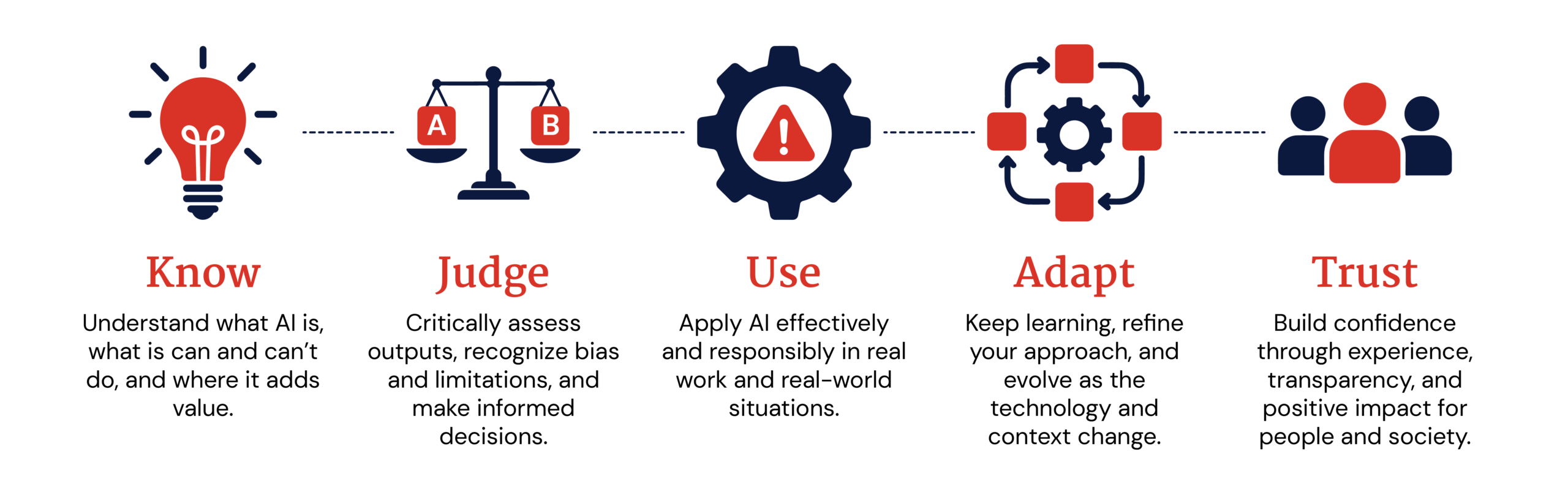
One way I’ve started thinking about readiness is through five simple ideas: Know → Judge → Use → Adapt → Trust
They aren’t necessarily five steps that happen neatly in order. They’re five things people may need if they’re going to work effectively in an AI-shaped environment.
Know
People need enough foundational understanding to make informed choices. They should know what the tools can do, where they tend to fail, what risks matter, and what their organization’s expectations are. Not everyone needs to understand how a large language model works under the hood. Rather, they should understand enough to avoid treating AI like either magic or a menace.
Judge
Judgement may be the most important part to AI readiness. When it comes to an AI output, people need to know when to trust, check it, challenge or revise it, ask another question to get a slightly different output, or just ignore it entirely. AI can produce an incorrect answer with the same confidence and polish as a correct one (maybe you have experienced this with AWKWARD consequences!) That means the user’s judgment becomes part of the quality-control system. Obviously, the more consequential the work is, the more important that judgment becomes.
Use
Knowing about AI doesn’t necessarily mean someone can use it well within a job. A generic prompt-writing session may be helpful, but a salesperson, analyst, manager, teacher, instructional designer, and healthcare professional aren’t doing the same work. Readiness becomes much more useful when people learn to apply AI inside the situations they actually encounter.
- What should a manager use AI for when preparing for a coaching conversation?
- How should an analyst use AI while protecting the integrity of the analysis?
- Where could a salesperson use AI to prepare for a customer meeting, and what should never be delegated?
Those are different learning problems, each requiring a different user intent.
Adapt
Whatever we teach about AI today will change. Tools will improve. Features will appear. Policies will evolve. Jobs and workflows will change. So, part of readiness is learning how to keep learning. People need enough confidence and curiosity to experiment responsibly, notice what’s working, question what’s not, and adjust their approach. The goal really shouldn’t be mastery of one tool. Instead, focus on developing adaptability as the work keeps changing.
Trust
Finally, people need enough clarity to use AI confidently. Which tools can I use? What data is appropriate? Who checks the output? Am I allowed to use AI for this task? Do I need to disclose it? What happens if AI gets something wrong? Unclear answers create predictable behavior. Some people will charge ahead. Others will freeze. Trust grows when expectations, safeguards, leadership behavior, and organizational practices line up.
Different readiness needs require different learning
This is where I think Learning and Development practitioners make a logical, but possibly ill-informed conclusion: “Everyone needs AI training!” Well, maybe. But what kind? For what purpose? And what should people actually be able to do afterward?
- If the need is primarily Know, a 15-minute Rise course may be exactly the right solution. People don’t need a six-hour workshop to learn which tools are approved and understand basic guidelines.
- If the need is Judge, information alone probably won’t be enough. Give people something to judge. Show an AI-generated response containing subtle errors. Ask learners what they would trust, what they would check, and what information is missing. Put them into a case where AI recommends one thing but the context suggests another. Let them talk through the decision. That’s a great use of instructor-led learning.
- If the need is Use, put people into the work. Have managers prepare for a difficult conversation. Let salespeople use AI to research or prepare for a customer scenario. Ask analysts to compare an AI-generated synthesis to the original source material. Give learners feedback and another chance to try.
- If the need is Adapt, the answer may extend beyond a course entirely. Maybe people need:
- follow-up practice,
- refreshed scenarios
- manager coaching
- performance support
- communities of practice
- office hours
- peer sharing
- or resources that evolve along with the tools.
- And if the challenge is Trust, organizations may need to make policies and expectations much easier to understand and apply. A standalone policy document has value. But, asking your team to respond to a realistic scenario asking, “Can I put this information into this tool?” may do more to change day-to-day behavior.
The point is not that one approach is better than another. It’s that the learning solution should match the performance need. Sometimes the right answer really is a short eLearning module. Sometimes it’s a six-hour instructor-led experience. Sometimes it’s a job aid sitting next to someone while they work. Often it’s a deliberately designed combination.
Readiness isn’t the same for everyone
There is another reason a single enterprise-wide AI course won’t solve everything; people do different work. There may be a foundation everyone needs. After that, however, the capabilities start to diverge.
- A salesperson might need to understand how to use AI for account preparation without allowing it to replace customer knowledge or relationship building.
- A manager may need to evaluate AI-assisted work, coach employees using AI, and recognize where overreliance is reducing someone’s capability.
- An analyst may need much deeper practice in evaluating sources, identifying unsupported conclusions, recognizing bias, and separating AI-generated patterns from defensible findings.
- A teacher may need to determine when AI supports student learning and when it allows a learner to skip the thinking the assignment was meant to develop.
So rather than simply asking, “What AI training does our organization need?”, try asking, “How is AI changing this role, and what does this person need to do differently because of it?” That’s a much more useful learning question.
There’s another risk: What happens when AI removes the learning?
This may be the part of the AI conversation that interests me most. Think about how people become good at something. Often it isn’t because someone gave them the answer.
- They struggled.
- They tried something.
- They got it wrong.
- They received feedback.
- They watched someone else.
- They wrestled with ambiguity.
- They explained their thinking.
- They reflected.
- Then they tried again.
AI can remove a lot of that friction. Sometimes that’s exactly what we want! Few people need the developmental experience of manually formatting the same information for the hundredth time. But some friction is different. Some friction is where learning happens.
- If AI immediately writes the response, did the learner practice writing?
- If it summarizes every complex source, did the analyst practice making sense of complex information?
- If it recommends the answer immediately, did the new manager practice diagnosing the situation?
- If it handles the difficult conversation, did the employee develop the interpersonal skill?
A few Harvard Business Review articles (Gratton, 2025; Duncan, 2026) have raised this same concern: AI can accelerate work and learning while potentially removing some of the struggle, choice, reflection, and interpersonal experience through which people develop expertise and professional judgment. To be clear, this is not an argument against AI. Rather, it’s a design question: Where should we remove friction, and where is the friction part of what develops capability? Learning professionals need to help answer that.
Judgment may become more valuable, not less
AI makes answers easier to generate. That doesn’t necessarily make thinking easier. In fact, it may create the opposite problem. When a polished answer appears instantly, people need the judgment to ask:
- Is this right?
- What is it assuming?
- What’s missing?
- Does this make sense for this situation?
- What evidence supports it?
- What shouldn’t I delegate?
In a recent article in ATD, Teague (2026) recently emphasized the same point, identifying judgment, critical thinking, communication, learning agility, ethics, collaboration, and leadership as increasingly important capabilities for people working alongside AI. Those qualities are not easily developed by simply telling someone what good judgment looks like. They often require experience which leads to reflection which leads to feedback and ultimately, if the learner is given the opportunity, another attempt. That’s familiar territory for good learning design.
It’s also why I don’t see AI as signaling the end of instructor-led learning. Quite the opposite. As information becomes easier to access, some of the highest-value learning may increasingly be the places where people come together to do things AI can’t conveniently do for them.
The content still matters. But practice and judgment may matter even more.
Managers have a role too
AI readiness also can’t live entirely with the L&D team. Managers will shape how people actually use these tools day to day. Employees will look to managers for cues: Is AI encouraged here? Where are the boundaries? What quality do you expect? What do I need to check? What happens when AI produces something wrong? Managers also need to notice when AI is helping someone grow, and when it may be masking a capability gap. That makes manager enablement an important part of readiness; not because managers need to become AI experts. Rather, they’re helping people learn how to perform in a changing environment.
The learning questions haven’t changed as much as we think
AI can make this all feel like an entirely new problem. In some ways it is. But many of the questions learning professionals need to answer are surprisingly familiar.
- What does good performance look like?
- What’s different from what people do today?
- What do people need to know?
- What do they need to practice?
- Where is judgment required?
- What can they simply look up?
- What learning experience fits the need?
- What should happen after the formal learning ends?
- How will we know whether someone can actually perform?
Those questions were useful before generative AI arrived. They continue to be useful now. And they’ll still be useful when today’s AI tools look primitive.
Preparing people for changing work
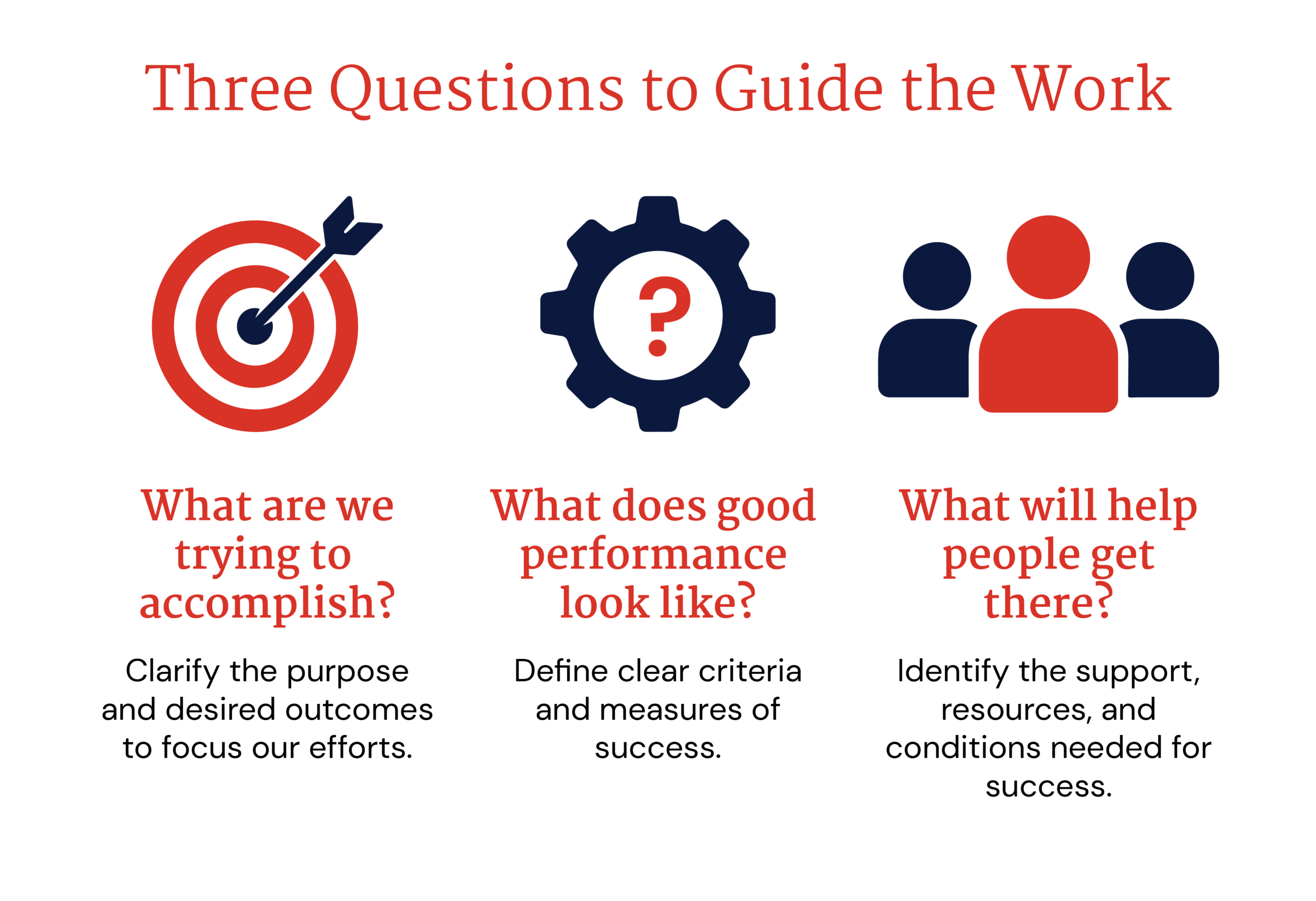
AI may change the tools. It may change workflows. In some cases, it may change the job itself. But organizations still have to answer three very human questions:
- What are we trying to accomplish?
- What does good performance look like?
- What will help people get there?
Sometimes the answer will involve AI. Sometimes it will be an instructor-led experience. Sometimes it will be a Rise course, simulation, job aid, coaching conversation, performance-support resource, or something we haven’t built before. The format isn’t the point. The capability is. Giving people AI is easy. Preparing people to use it wisely, while continuing to develop the judgment, confidence, and human capability the work requires, is a much more interesting challenge.
And it’s a learning challenge worth getting right.
Works Cited
Duncan, D. S. (2026, February 3). How do workers develop good judgment in the AI era? Harvard Business Review. https://hbr.org/2026/02/how-do-workers-develop-good-judgment-in-the-ai-era
Gratton, L. (2025, December 22). AI is changing how we learn at work. Harvard Business Review. https://hbr.org/2025/12/ai-is-changing-how-we-learn-at-work Harvard Business Review
Teague, C. L. (2026, June 28). The human skills that will matter most in the age of AI: A practical guide for L&D leaders. Association for Talent Development. https://www.td.org/content/atd-blog/the-human-skills-that-will-matter-most-in-the-age-of-ai-a-practical-guide-for-l-and-d-leaders
For further reading
Harvard Business Review — AI Is Changing How We Learn at Work, by Lynda Gratton
A thoughtful look at how AI may speed up learning and work while also changing the experiences through which people develop mastery, judgment, agency, empathy, and professional identity.
ATD — The Human Skills That Will Matter Most in the Age of AI: A Practical Guide for L&D Leaders by Courtney Teague
A useful companion for thinking beyond tool proficiency toward judgment, critical thinking, communication, adaptability, ethics, collaboration, and leadership.
Ethan Mollick – Read his book Co-Intelligence or Subscribe to the One Useful Thing newsletter (free or paid versions) on Substack
A note on how this article was developed: I intentionally used generative AI as a thought partner in developing portions of this article—not as a replacement for human judgment. I guided the process, challenged and refined the output, and take responsibility for the final ideas and language. In doing so, I aimed to model Vivayic’s approach to AI: use it when it supports the outcome, preserve the human contribution, and be transparent about its role.
