


What do the following scenarios have in common?
A growing organization searching for a more efficient and consistent way to onboard new staff to their roles.
A trade association searching for a way to disseminate and track training on a time-sensitive industry topic as a benefit to their members.
An NGO searching for a way to scale their traditional boots-on-the-ground training to a large global audience in a more cost-effective and sustainable manner.
All three of these scenarios represent common challenges that are solvable with a Learning Management System (LMS). Selecting an LMS can feel overwhelming given the large number of choices on the market. If you were to search the term “Learning Management System,” you would be bombarded with hundreds of results – all claiming they’re the right fit for your organization. Finding the right fit doesn’t have to be difficult or require a PhD in learning technology; it involves answering a few non-technical questions to ensure you know what you’re looking for when you begin searching for a system to support learning.
This article is the first in a three-part series that will introduce you to three essential considerations to help cut through all the noise of today’s LMS marketplace – Strategy > Scope > Solution.
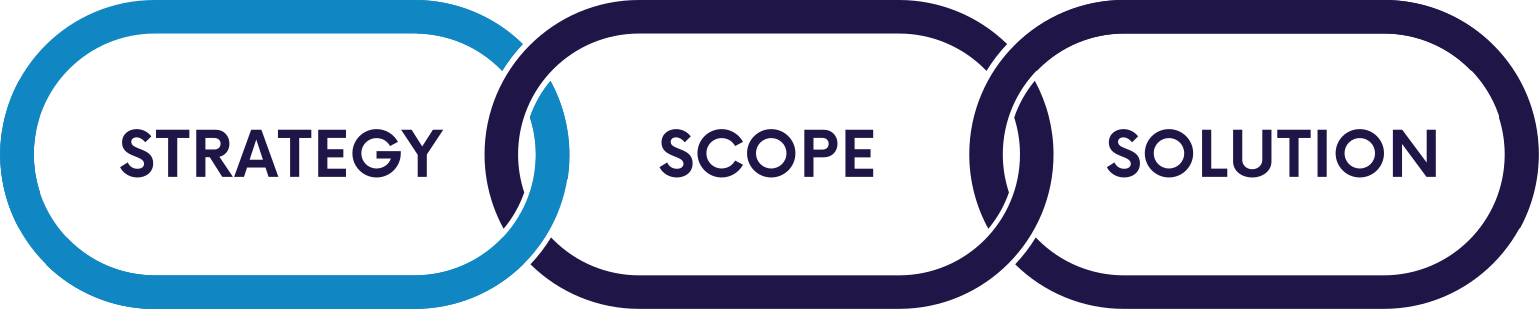
In this first post, we’ll explore some questions to help you clarify your strategy. With clarity on your goals, success measures, and priority audiences, you’ll have the strategic foundation for your LMS. The next step is determining what that strategy means in practical terms—what the system must do, and what constraints shape your options.
What is an LMS?
An LMS is a software platform that enables organizations to deliver, manage, and track training and educational content. It serves as a centralized hub for learning activities, allowing administrators, and in some cases trainers or instructors, to create courses, assign them to users, monitor progress, and generate reports. Beyond the baseline functionality, an LMS ultimately enables delivery of learning experiences that support an organization’s goals and objectives. When it is unclear what organizational goals the LMS needs to support, it’s easy for the bells and whistles and shiny features to become noise when evaluating options. Before thinking about features (scope) or specific platforms (solutions), it’s worth stepping back and asking the question: What are we trying to achieve? A clear strategy acts as a filter—helping you focus on what matters most and ignore features that don’t serve your goals.
Common Goals Supported by an LMS
Learning Management Systems can support a wide variety of organizational goals and objectives. Here are just a few examples from our experience helping clients find and implement an LMS that meets their needs.
Operational Efficiency
- Automating tracking and reporting of learning experiences
- Maximizing training budget by moving some training experiences online
- Meeting regulatory or certification requirements
Building Capacity
- Reducing the time-to-productivity and retention with effective onboarding
- Developing technical skills necessary to contribute to the organization’s KPIs
- Building new skills to support a new strategic initiative or direction
Amplifying Impact
- Serving external audiences related to your mission (e.g., members, volunteers)
- Disseminating knowledge as a public good or monetizing intellectual property
- Improving the customer experience with your product or service
Improving Learning
- Curating a centralized repository of high-quality learning assets and experiences
- Improving the consistency of training experiences for all learners
- Creating learning pathways to support retention and transfer
Clarifying Your LMS Strategy
Once you recognize which outcomes matter most to your organization, the next step is clarifying your LMS strategy. Defining your strategy doesn’t require technical expertise – it requires answering three simple questions.
What’s your goal?
Most successful LMS implementations prioritize one or two primary goals rather than trying to solve everything at once. Consider the following questions to clarify your goal:
- What problem are we trying to solve with the LMS?
- What will be different six or twelve months after implementation?
- Which organizational priorities does learning need to support?
What does success look like?
This is an essential step that many organizations skip. If you aren’t clear about how you’ll measure success, it’s easy to get lost in the minutiae (and friction) involved with launching a new system. Below are a few examples. Consider what success looks like for your goals.
If your goal is… | Success might look like… |
Improving employee onboarding | Time-to-productivity decreases; retention increases |
Upskilling for a new product launch | Change in sales team behavior/approach; salesperson confidence increases |
Helping association members solve an industry-wide problem | Instances of the issue decrease; Positive sentiment regarding member value increases |
Who are you serving? How will they use the system?
Defining the key stakeholder groups that stand to either engage in learning experiences through the LMS or benefit from its implementation is an essential aspect of your LMS strategy. Clarity here helps to prevent overbuilding – or underbuilding – your LMS. Here are some groups to consider:
- Learners – Who will access the LMS to engage in the learning experiences you offer?
- Instructors – Who might be involved in facilitating the learning experiences?
- Administrators – Who will be using features of the system to govern the experience?
- Managers – Who will be encouraging learning and holding learners accountable?
- Leadership – Who will want to monitor overall results and goal progress?
- Auditors – Often, external; Who might need to receive reports from the system?
You may or may not need to consider all these groups. Which groups matter most as you think about your goal? The most successful implementations typically prioritize the needs of one or two of these groups as they consider the right solution for their needs. You know your goals best, pick the top 2-3 groups and consider the following:
- Are they internal, external, or both?
- What is their level of experience with technology, specifically an LMS?
- How do they engage with learning experiences now?
- How frequently will they engage with the LMS?
- What do you think their priorities are for the LMS?
- What are 3-5 “day in the life” scenarios (a.k.a. use cases) where the selected group would use the LMS? (e.g., onboarding a new hire, completing a course to earn a CEU credit, renewing a certification, running a webinar series, generating a report)
Bringing it Home and Looking Ahead
With a clearer sense of your LMS strategy—your goals, measures of success, and audiences—you’re better positioned to define the scope of your solution. In the next article, we’ll explore how to translate strategy into practical decisions about the features that matter most to your unique need.
Start with Strategy
Ready to explore how an LMS can benefit your organization? Download the LMS Strategy Worksheet to start identifying your LMS Strategy.